In January 2025 Warren told the state it owes 181 affordable units, not 262, and the mayor voted no
Resolution 2025-064 passed 4 to 1 on January 30, 2025, substituting a 181 unit prospective need obligation for the state's 262 and sending the township to court within 48 hours. Mayor Lontai cast the lone no vote.

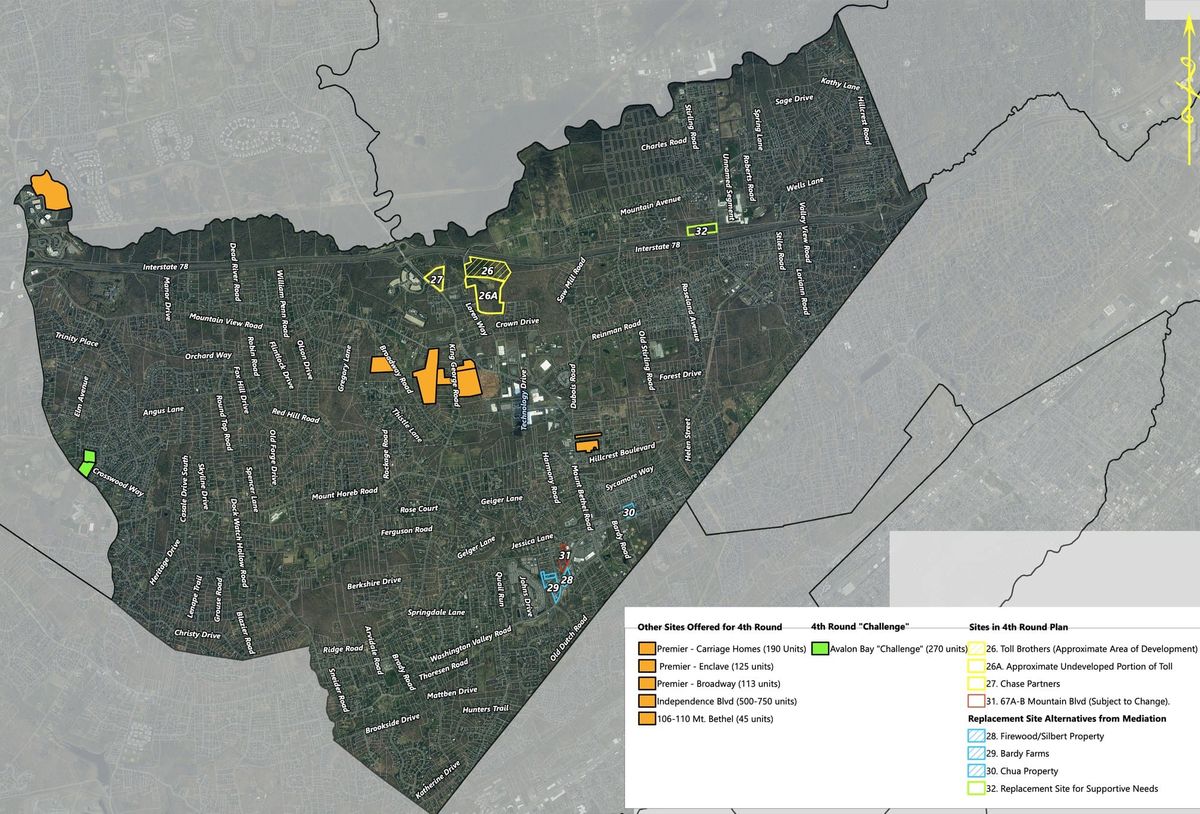
This story updates the development pipeline, the running file that carries the current status.
At a special meeting on January 30, 2025 the Warren Township Committee adopted Resolution 2025-064 by a vote of 4 to 1, establishing the township's Fourth Round affordable housing obligation at 10 Present Need units and 181 Prospective Need units. The New Jersey Department of Community Affairs had calculated Warren's 2025 to 2035 obligation at 10 Present Need and 262 Prospective Need units in a report dated October 18, 2024. The resolution directed the Township Attorney to file a Declaratory Judgment Complaint within 48 hours, and the complaint was filed January 31, 2025. Mayor Victoria Lontai cast the only no vote.
The meeting was called to order at 7:33 p.m. It was a special meeting, which is what municipalities hold when a statutory clock is running and the regular calendar will not get there in time.
The clock in question comes from New Jersey's 2024 amendments to the Fair Housing Act. Those amendments retired the old Council on Affordable Housing process and replaced it with two things: a calculation performed by the Department of Community Affairs, and a court supervised compliance program. Municipalities were given a narrow window to either accept the DCA number or substitute their own and then defend it in court.
Warren substituted its own.
The two numbers
| Source | Present Need | Prospective Need |
|---|---|---|
| DCA report, October 18, 2024 | 10 | 262 |
| Warren, Resolution 2025-064 | 10 | 181 |
The present need figure is identical in both. The disagreement is entirely in prospective need, which is the forward looking obligation for 2025 through 2035. The gap is 81 units.
How Warren got to 181
The resolution recites the method. The township's affordable housing planner re-examined the land capacity factor the DCA had used, testing it against three local data sets:
- MOD-IV tax list data
- construction permit data
- land use board approvals
Land capacity is the part of the state formula that asks how much developable land a municipality actually has. It is also the part most open to argument, because a statewide model working from statewide data can carry assumptions that a town with its own permit records and approval history can dispute with specifics. That is the argument Warren made.
Having made it, the township adopted 10 Present Need and 181 Prospective Need as its own binding figure.
The 48 hour clause
Resolution 2025-064 directed the Township Attorney to file a Declaratory Judgment Complaint within 48 hours, or by February 3, 2025, whichever came sooner. The authority cited is Administrative Office of the Courts Directive 14-24.
The complaint was filed January 31, 2025.
A declaratory judgment action here is the municipality asking a court to declare what its obligation is. Filing it is also what preserves a town's protection against builder remedy litigation while the number is being fought over. That is why the deadline is measured in hours rather than weeks.
Committeeman Fine noted on the record that a challenge period would run from February 1 to February 28. That is the window in which interested parties, including Fair Share Housing Center and builder interests, could contest the township's substituted number.
The roll call
| Member | Vote |
|---|---|
| Blick | Yes |
| Kian | Yes |
| Fine | Yes |
| Croson | Yes |
| Lontai | No |
The mayor's no vote, in her own framing
Mayor Lontai stated that her no vote was philosophical opposition to a law that places these obligations in the hands of unelected judges rather than elected legislators. She also noted that the resolution already had the votes to pass.
Both parts of that matter. The first is an objection to the structure of the statute, not to the 181 figure. The second is the mayor saying out loud that her vote was not going to change the outcome. Read together, it is a recorded objection to the framework rather than a dispute with her four colleagues about Warren's land capacity.
I am not going to characterize it further. The minutes carry her stated reason, and that is the whole of the public record on the point.
What this vote did and did not settle
It did not settle the number. It opened the argument. A municipality adopting its own figure under the amended Fair Housing Act is making a claim that a court will either accept or replace. Filing within 48 hours preserved Warren's position and its protection from builder remedy suits while that played out.
What happens next runs on a clock the township does not control. The challenge period Fine described opens February 1, and any objection filed in it puts the number in front of a Mount Laurel judge.
If you own property in Warren and want to know whether any of this touches your block, the honest answer at this stage of the timeline is that nothing had been rezoned. A prospective need number is a total the township has to plan for. Where the units go is a separate set of decisions, made later, through ordinances with public hearings.
The docket number of the Declaratory Judgment Complaint filed January 31, 2025 is not in the record I worked from. I have not published one rather than guess at it.
- Township of Warren, Special Meeting Minutes and Resolution 2025-064, January 30, 2025. https://www.warrennj.org/AgendaCenter/ViewFile/Minutes/_01302025-837
- Township of Warren, Resolution 2025-144, adopted June 26, 2025, reciting this case history (archival citation). https://www.warrennj.org/AgendaCenter/ViewFile/Minutes/_06262025-882

John Mangini
Broker / Owner, NextHome Premier

Warren Township resident and full time broker, licensed in New Jersey since 2002. Warren, Local. is written from live Garden State MLS data, township records and primary sources. Every figure is traceable to a source listed above.